B2B SaaS SEO is the process of getting your software company found by the right buyers — on Google, on ChatGPT, on Perplexity, and everywhere else your prospects are researching solutions before they ever fill out a contact form.
It is not about writing more blog posts. It is not about stuffing keywords into your homepage. It is about making sure that when a founder or VP of Engineering types a question into Google or asks ChatGPT to recommend an app development company, your name shows up in the answer.
This is the story of how we did exactly that for one B2B SaaS app development company — and what it produced in six months.
Who This SaaS SEO Case Study Is For
If you are a SaaS founder or marketing lead who:
- Has a site with decent content but organic traffic is not growing
- Is spending on paid ads because SEO “never really worked”
- Has never appeared on ChatGPT, Perplexity, or Google AI Overviews
- Watches competitors with worse products outrank you on Google
This is for you.
Where They Started
When this B2B SaaS app development company came to Spaceload, the numbers looked like this:
- DR 42 — decent for an early-stage SaaS company, but not enough to compete on the commercial keywords buyers actually search
- 1,600 monthly organic visitors — almost entirely people who already knew the brand; cold traffic from search was near zero
- Zero AI search presence — not appearing on ChatGPT, Perplexity, Google AI Overviews, or any other AI platform buyers were using to research vendors
- Thin backlink profile — not enough sites linking to them to signal to Google that they were a credible authority in their space
The problem was not that the content was bad. It was that Google and AI platforms had no strong reason to trust them over more established competitors. That is a very different problem to solve — and it requires a very different approach than just publishing more blogs.
What We Did — In the Exact Order We Did It
Step 1: Technical SEO — Fix the Foundation Before Any SaaS SEO Case Study Results Are Possible
Most SaaS companies jump straight to content or link building. That is a mistake.
If Google cannot properly crawl and understand your site, every blog post you publish and every link you earn will underperform. You are building on a broken foundation.
Before writing a single piece of content or building a single link, we ran a full technical SEO audit of the site. Here is what we found:
Pages Google was not indexing properly. Several important service pages were being crawled inconsistently. New content was taking weeks to get picked up instead of days.
Internal links not doing their job. The site had content, but the link structure meant that the most important commercial pages — the ones that needed to rank — were not getting enough internal authority passed to them. They were effectively isolated.
No structured data anywhere. Schema markup is what tells Google and AI platforms exactly what your page is about — and it is what makes you eligible for rich results and AI Overview inclusion. This site had none. That alone was costing significant visibility.
Underperforming title tags and meta descriptions. Several pages were getting thousands of impressions in Google but almost nobody was clicking. That is a CTR problem, not a rankings problem — and it is fixable in days, not months. Simple rewrites delivered measurable improvements within the first four weeks.
This foundation work is not glamorous. But it is what makes everything else work. There is no point building links to a site Google cannot properly crawl.
Step 2: Keyword Research — Find What Buyers Actually Search, Not What Looks Good in a Report
Once the technical foundation was solid, the focus shifted to keywords.
Not keyword volume. Keyword intent.
The question we built the entire strategy around was: what does a founder or engineering leader type into Google — or ask ChatGPT — right before they decide to hire an app development company?
Those are the keywords worth targeting. Not the ones with the highest search volume. The ones that indicate the buyer is ready to evaluate a vendor.
Bottom-funnel keywords — people ready to hire:
- Custom app development company
- B2B software development agency
- Hire app developers for SaaS
Comparison intent — people weighing options:
- Best app development companies
- App dev company vs freelancer
- Alternatives to [competitor]
Problem-aware — people realising they need help:
- How to build a B2B SaaS app
- Custom software development cost
- When to outsource app development
Every keyword went through three filters before entering the strategy:
Keyword difficulty. We targeted KD 0 to 20 — keywords where a site at this domain authority level can realistically reach page one without needing hundreds of backlinks.
Search volume. Niche buyer-intent keywords with 100 to 500 monthly searches consistently outperform broad terms chased for volume alone. A hundred searches from people about to hire beats ten thousand searches from people who are not.
Ranking potential. Every keyword was validated against the current top ten results to confirm the site could realistically compete and earn its place.
Every piece of content was also structured from day one for AI search eligibility — answer-first formatting, FAQ sections, and the conversational phrasing buyers use when they ask ChatGPT or Perplexity for vendor recommendations. This is the foundation of our AI SEO approach and it is built into every content brief we write.
Step 3: Link Building — The Part Most SaaS Companies Skip or Do Wrong
Here is the uncomfortable truth about SaaS SEO: content alone will not move your domain rating, and a low domain rating caps how competitive you can be on the keywords that matter.
You need other websites — credible, relevant ones — to reference and link to you.
We ran manual outreach to niche-relevant publishers in the software development, SaaS, and B2B tech space, targeting sites with DR 40 to 70.
No directory submissions. No link farms. No paid placements disguised as editorial coverage.
Around 200 editorially earned links, built through real outreach to real publishers who cover the space this client operates in.
Those 200 links pushed DR from 42 to 57 — a 15-point increase. That shift tells Google that the wider internet considers this site a credible source in its space. And that credibility flows into rankings across all content on the site, not just the pages where links were built directly.
Step 4: AI Search Visibility — The Channel Most SEO Agencies Ignore Completely
This is where most SaaS SEO services stop. We do not.
A growing share of B2B buyers now use AI tools — ChatGPT, Perplexity, Google AI Mode, Gemini — to research vendors before ever visiting a website. They ask questions like “what are the best B2B app development companies” or “who should I hire to build a SaaS product” and they get back a list of names with explanations.
If your company is not in those answers, you are invisible to that slice of the market. And that slice is growing every month.
For this client, we optimised every key page for AI citation eligibility as part of our AI SEO strategy:
- Restructured content to lead with direct answers before expanding into detail
- Added FAQ schema to all service and comparison pages
- Strengthened entity signals so AI platforms could clearly identify and categorise the brand
- Rewrote key pages around the conversational queries buyers use with AI tools
The result was citation appearances across six AI platforms — including several the client had never appeared on at all before we started.
SaaS SEO Case Study Results: The Numbers After Six Months
Here is what moved over the six-month engagement, pulled directly from Ahrefs and Google Search Console:
| Metric | Before | After |
|---|---|---|
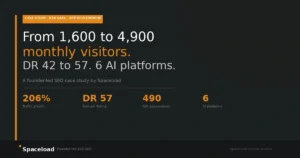
| Monthly organic visits | 1,600 | 4,900 (+206%) |
| Domain Rating | DR 42 | DR 57 |
| Editorial backlinks | Thin | 200+ |
| Referring domains | Low | ~200 |
| Organic keywords | Low | 7,600 (+40%) |
| AI search citations | 0 | 6 platforms |
| AIO search appearances | 0 | 490 (+347) |
| ChatGPT citations | 0 | 246 (new) |
| Google AI Overviews | 0 | 138 (+69) |
| Grok | 0 | 469 (new) |
| Perplexity | 0 | 19 (new) |
| Gemini | 0 | 31 (new) |
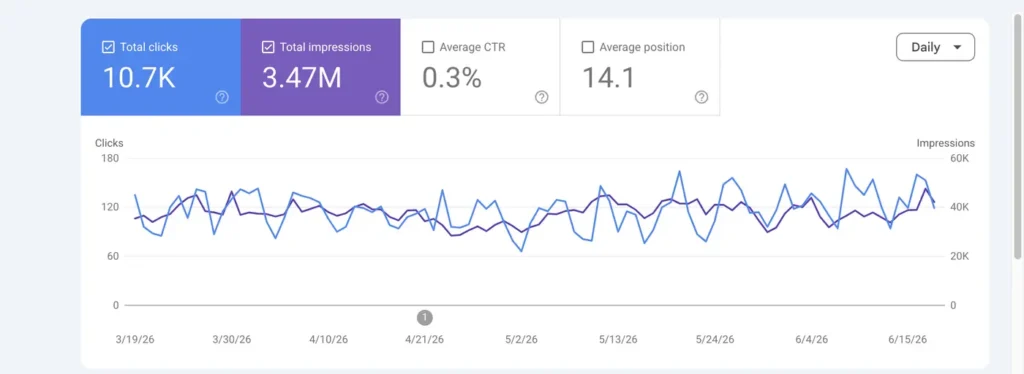
Google Search Console recorded 10.7K clicks and 3.47M impressions across the engagement period.
What This Actually Means for a SaaS Founder
Let us translate these numbers into what they mean for the business:
206% more organic traffic means more than three times as many potential buyers landing on the site every month without paying for ads. That traffic compounds. Unlike paid, it does not stop the moment you pause spend.
246 ChatGPT citations means that when a founder asks ChatGPT to recommend an app development company, this client’s name appears in the answer. That is pipeline that never showed up in any previous analytics report — because it was happening in a tool the business had no visibility into.
DR 57 means the site now has enough credibility to compete for commercial keywords that were previously unreachable. Every new piece of content published now starts from a stronger position than anything published before.
What This SaaS SEO Case Study Proves
A few things worth understanding before you try to replicate this:
Order matters more than tactics. Technical SEO first. Then content. Then links. Then AI search. Skipping steps or doing them in the wrong order is the reason most SaaS SEO engagements stall before producing results.
Intent beats volume every time. The keywords that actually drove pipeline in this engagement were not the highest-volume ones. They were the ones buyers searched at the exact moment they were ready to evaluate a vendor.
AI search is not a future consideration. It is happening now. 246 ChatGPT citations means buyers in this niche are finding this company through AI before running a single Google search. That share is growing, not shrinking.
Your domain rating is a ceiling. Until you build enough credible links to raise it, your content will consistently underperform regardless of quality. Link building is not optional — it is what unlocks everything else.
Want to See What This Looks Like for Your Company?
If your SaaS site is getting impressions but not clicks, traffic but not demos, or if you are simply invisible on AI platforms your buyers use every day — the problem is usually the same one we solved here.
Spaceload does SEO and AI search visibility for B2B SaaS companies. No generalist work. No junior handoffs. Every engagement is founder-led from day one.
We also work with companies at a similar stage — see how we helped a SaaS staffing platform grow from 30 to 368 monthly visits using the same process.
Book a free 30-minute strategy call →
Frequently Asked Questions
How long does it take to grow organic traffic for a SaaS company?
In this engagement, technical fixes delivered measurable wins within four weeks. Content and keyword rankings began moving within 60 to 90 days. Link building and AI citations compounded over the full six months. Most SaaS companies see meaningful organic growth between months three and six, with compounding results beyond that.
Do I need to be on ChatGPT and Perplexity as well as Google?
Yes — if your buyers are using AI tools to research vendors (and in B2B SaaS, they are), then not appearing in those results means you are invisible to a portion of your market. AI search visibility is built into every Spaceload engagement through our AI SEO services.
What kind of backlinks actually move domain rating for SaaS companies?
Editorial placements on niche-relevant publishers — sites that cover software development, SaaS, and B2B tech — with domain ratings between 40 and 70. Directories, link farms, and paid placements do not move DR in any meaningful or lasting way.
How is SaaS SEO different from regular SEO?
SaaS buyers have longer research cycles, use more comparison and alternative searches, and increasingly start their research on AI platforms rather than Google. SaaS SEO needs to account for all of these — which is why intent mapping, AI search optimisation, and topical cluster architecture matter more in this space than in most others.
What is the difference between AEO and GEO?
Answer Engine Optimisation targets direct answer placements — Google AI Overviews and featured snippets. Generative Engine Optimisation targets citations within AI-generated responses on ChatGPT, Perplexity, Gemini, and similar platforms. Both are built into every Spaceload engagement by default — not sold as add-ons.
Can this work if my SaaS company is early stage with a low domain rating?
Yes. This client started at DR 42 — not high. The strategy accounts for current authority level and targets keywords that are winnable at that DR, while building the link profile needed to unlock more competitive terms over time. Book a call and we will give you an honest assessment of where your leverage is right now.